
If your child receives ABA therapy at home and also has an Individualized Education Program (IEP) at school, you may feel like you’re managing two separate worlds. Different goals, different strategies, different teams — and you in the middle, trying to make sense of it all.
The good news: these two worlds can — and should — work together. When your child’s school team and ABA team are aligned, your child gets a consistent, reinforcing experience across every environment they spend time in. That kind of consistency is one of the most research-backed drivers of progress for children with Autism Spectrum Disorder.
Here’s how to make it happen.
1. Understand the Difference Between Your Child’s IEP and ABA Plan
Your child’s IEP is a legally binding document developed by their school team that outlines academic and developmental goals, accommodations, and services provided in the school setting. Your child’s ABA treatment plan, on the other hand, is developed by a Board Certified Behavior Analyst (BCBA) and focuses on behavior, communication, daily living skills, and social development — often targeting the home and community environments.
Both plans are valuable — and often target overlapping skills from different angles. Understanding both helps you spot where they complement each other and where gaps might exist.
2. Share Information Between Teams
One of the simplest and most impactful things you can do is facilitate communication between your child’s school team and their BCBA. With your permission, a BCBA can:
- Review your child’s IEP goals and look for alignment with ABA treatment targets
- Share data and progress notes that may inform the school team’s decisions
- Recommend classroom accommodations that are consistent with your child’s behavioral needs
- Attend IEP meetings as a consultant (with your permission and the school’s cooperation)
Ask your BCBA if they’re willing to collaborate with the school team — most BCBAs welcome this kind of coordination because it directly benefits their client.
Recent Posts
- Halloween Is a Skill-Building Season: A Behavior-Minded Guide for Autism Families
- Early Intervention ABA Therapy in Fair Lawn, NJ: Why Starting Early Changes Everything
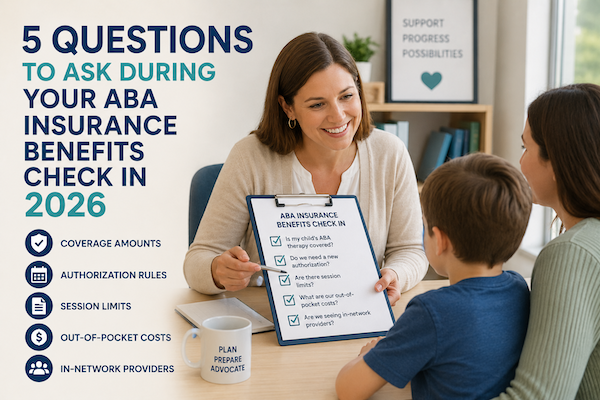
- 5 Questions to Ask During Your ABA Insurance Benefits Check in 2026
- What Horizon NJ Health’s New 2026 ABA Policy Means for Your Child’s Coverage
- Why Autism Looks So Different Person to Person
3. Questions to Ask at Your Child’s Next IEP Meeting
IEP meetings can feel overwhelming, especially when you’re sitting across from a large team of educators and specialists. Going in with prepared questions makes a big difference. Here are some to consider:
- How are my child’s behavioral needs being addressed in the classroom? What strategies are staff using?
- Is there a Behavior Intervention Plan (BIP) in place? Can I get a copy?
- How is my child’s progress on IEP goals being measured and communicated to me?
- Can my child’s ABA provider be invited to collaborate with the school team or observe?
- What strategies does the school use for transitions, sensory challenges, or emotional regulation — and how can we align those with what’s happening at home?
4. Reinforce School Skills at Home (and Vice Versa)
Generalization — the ability to use a skill in a new setting — is one of the core goals of ABA therapy. A child who learns to raise their hand in therapy but never does it at school hasn’t yet fully acquired the skill.
Talk to both teams about what skills are being worked on in each setting, and look for intentional ways to practice them across environments. For example, if your child is working on self-regulation strategies in their ABA sessions, ask whether those same strategies can be introduced in the classroom with teacher support.
5. You Are the Constant: Use That Power
Teachers change. Therapists rotate. But you are the one constant across every environment your child navigates. That makes you uniquely powerful — and uniquely positioned to advocate for consistency.
Don’t hesitate to push for communication between teams, to ask clarifying questions, or to request that strategies be aligned. You don’t need to be a behavior analyst or a special education expert to ask for what your child needs — you just need to show up, ask questions, and keep the focus on what’s working.
How AGBS Can Help
At AG Behavioral Services, our BCBAs are experienced in collaborating with school teams and supporting families through the IEP process. Whether you need guidance on how to read an IEP, want your BCBA to communicate directly with your child’s teachers, or are looking for strategies to bridge the gap between school and home — we’re here for all of it.
Reach out to the AGBS team today to learn more about how we support the whole child — in every environment they grow in.
AGBS provides ongoing care for children, adolescents, and young adults with autism to improve the quality of their lives. If you would like learn more about how AGBS can help please contact us here , or call 908-913-0443.