
Starting ABA therapy brings hope, but also questions about what progress will look like and when you’ll start seeing changes. At AG Behavioral Services, we know that understanding the trajectory of ABA therapy helps families stay encouraged through the process and recognize meaningful improvements as they occur. This guide explains what to expect during your child’s first six months of ABA services.
The First Month: Building Rapport and Baseline Assessment
The initial weeks of ABA therapy focus heavily on relationship-building and gathering comprehensive information about your child’s current abilities. While this might not look like intensive teaching yet, it’s essential groundwork that determines the success of everything that follows.
Your behavior technician works to become someone your child trusts and enjoys spending time with. They’ll engage in preferred activities, follow your child’s lead during play, and begin learning what motivates your child. This relationship becomes the foundation for all future learning—children learn best from people they’re comfortable with.
During this time, the Board Certified Behavior Analyst (BCBA) conducts thorough assessments across multiple developmental areas. These might include standardized assessments like the VB-MAPP, ABLLS-R, or other evaluation tools, along with direct observation of your child in various settings and activities. The BCBA also conducts a functional behavior assessment if your child exhibits challenging behaviors, working to understand what triggers these behaviors and what functions they serve.
By the end of the first month, you should have a comprehensive treatment plan outlining specific goals across relevant skill areas. Your BCBA will review this plan with you, explaining the reasoning behind each goal and the teaching strategies that will be used.
Recent Posts
- Halloween Is a Skill-Building Season: A Behavior-Minded Guide for Autism Families
- Early Intervention ABA Therapy in Fair Lawn, NJ: Why Starting Early Changes Everything
- 5 Questions to Ask During Your ABA Insurance Benefits Check in 2026
- What Horizon NJ Health’s New 2026 ABA Policy Means for Your Child’s Coverage
- Why Autism Looks So Different Person to Person
Months 2-3: Active Skill Building Begins
Once the treatment plan is in place, therapy becomes more structured and goal-directed. The behavior technician begins systematically teaching target skills using evidence-based ABA techniques. This is when you’ll start noticing the first signs of progress.
Early wins often occur in areas where your child already has some emerging skills. Perhaps your child occasionally imitates actions—now they’re learning to imitate on command consistently. Maybe they use a few words spontaneously—now they’re learning to request specific items using those words reliably.
You might notice your child becoming more attentive during therapy sessions, following simple instructions more consistently, or showing increased interest in interactive activities. These improvements in attending and compliance are foundational—they enable learning in all other areas.
During this period, parent training intensifies. The BCBA and behavior technician teach you specific strategies to reinforce skills your child is learning. You’ll practice using prompts, providing reinforcement, and handling challenging behaviors consistently with the therapy team’s approach. This consistency between therapy sessions and daily life accelerates progress significantly.
Months 4-6: Consolidating Skills and Expanding Goals
By the four-month mark, many children have mastered several initial goals and are ready for more advanced targets. The focus shifts from learning new skills in structured settings to using those skills more independently and in natural contexts.
If your child learned to request items during tabletop activities, they’re now learning to request throughout the day—at snack time, during outdoor play, when they want a toy from a high shelf. This generalization across settings and situations is crucial for making therapy gains functional in everyday life.
The level of prompting decreases as your child becomes more independent with practiced skills. Where the therapist once provided hand-over-hand guidance for a task, now a gesture might be sufficient. Where they once modeled the correct response every time, now they wait to see if your child can do it independently first.
You’ll likely see improvements in multiple areas simultaneously. As communication skills develop, challenging behaviors often decrease—your child has more appropriate ways to get their needs met. As attending and compliance improve, learning happens faster across all domains. These interconnected improvements create momentum.
How Progress Is Measured
ABA therapy’s strength lies in its data-driven approach. Rather than relying on subjective impressions, progress is measured objectively through systematic data collection during every session.
For each target skill, the behavior technician records specific data. This might be the percentage of times your child responds correctly without prompting, the number of times they initiate communication during a session, the duration they can attend to an activity, or the frequency of specific challenging behaviors.
The BCBA reviews this data regularly, looking for trends that indicate progress, plateaus that suggest a need for strategy changes, or new patterns that require attention. Data analysis happens weekly or bi-weekly, with more comprehensive reviews monthly.
You’ll receive regular progress reports showing this data in understandable formats—often graphs that clearly illustrate improvement over time. These reports typically include updates on each goal area, noting skills that have been mastered, skills in progress, and any concerns or recommendations.
Progress Indicators Across Different Skill Areas
Progress manifests differently depending on which skills your child is working on. Understanding what improvements look like in various developmental areas helps you recognize and celebrate gains as they occur.
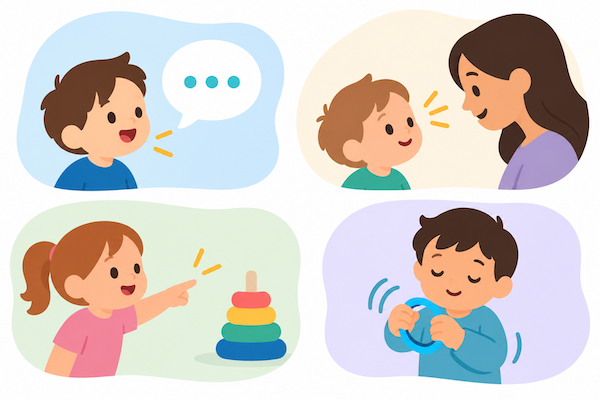
In communication and language, early progress might include increased vocalizations, more consistent eye contact during interactions, following simple one-step directions, requesting preferred items using words or communication devices, or imitating sounds and words more readily. As skills develop further, you might see your child combining words into phrases, answering simple questions, initiating conversations, or using language for various functions beyond just requesting.
For social skills, initial improvements often involve increased awareness of others, responding when their name is called, taking turns in simple games, or tolerating peers nearby during play. Progressive gains include initiating interactions with familiar people, engaging in simple back-and-forth play, showing interest in what others are doing, or beginning to play cooperatively rather than just parallel play.
In daily living skills, you might notice your child participating more in self-care routines, feeding themselves with less assistance, cooperating during dressing, or beginning to complete simple chores like putting toys away. More advanced progress includes greater independence in these areas and learning new skills like toothbrushing, handwashing, or simple meal preparation tasks.
For challenging behaviors, success means seeing the frequency, intensity, or duration of problem behaviors decrease. Perhaps tantrums are shorter or happen less often. Maybe aggressive behaviors are declining as your child learns more appropriate ways to communicate frustration or seek attention.
When Progress Looks Different Than Expected
Not every child progresses at the same rate, and progress isn’t always linear. Some children show rapid improvement in certain areas while others develop more slowly. Some children make steady progress, while others seem to plateau before making sudden leaps forward.
If progress is slower than hoped, your BCBA will analyze the data to determine why. Perhaps the goals need to be broken down into smaller steps. Maybe the reinforcement strategy needs adjustment. The teaching approach might need modification, or there could be factors outside of therapy affecting learning—like medical issues, sleep problems, or significant changes at home.
This ongoing assessment and adjustment is what makes ABA therapy effective. Rather than continuing with strategies that aren’t working, the BCBA systematically tries different approaches until finding what helps your child learn best.
It’s also important to recognize that some skills take longer to develop than others. Complex skills like flexible thinking, emotional regulation, or sophisticated social interactions naturally require more time than simpler skills like following basic instructions or imitating actions.
The Importance of Parent Training
Your involvement significantly impacts how quickly and how well your child progresses. Children who receive 20 hours of therapy per week still spend many more hours outside of therapy. When parents reinforce skills throughout daily activities, progress accelerates.
Parent training teaches you to recognize teaching opportunities in everyday moments. Putting on shoes becomes a chance to practice following multi-step directions. Grocery shopping becomes an opportunity for communication and learning about choices. Bedtime routines incorporate calming strategies and self-care skills.
The BCBA and behavior technician will teach you specific techniques: how to give clear, effective instructions; when and how to provide prompts to help your child succeed; what type of reinforcement works best for your child; strategies for preventing or responding to challenging behaviors; and ways to create learning opportunities during daily activities.
At first, implementing these strategies might feel awkward or require significant thought. With practice, they become more natural. Many parents find that ABA principles help them communicate more effectively with all their children, not just the one receiving services.
Realistic Expectations for Six Months
After six months of consistent ABA therapy, most children will have shown measurable progress in multiple areas. The specific gains depend on your child’s starting point, the intensity of services, which goals were prioritized, and various individual factors.
Some children will have mastered numerous goals and moved on to more advanced targets. Others might still be working on foundational skills but showing steady improvement. Both scenarios represent meaningful progress—what matters is that your child is learning and developing beyond where they started.
You should expect to see improvements in at least some goal areas, increased independence in certain skills, better understanding between you and your child as communication improves, and reduced frequency or severity of at least some challenging behaviors. You should also notice your child showing more interest in learning and engagement during therapy sessions, and you’ll feel more confident in your ability to support your child’s development.
Six months is really just the beginning. ABA therapy typically continues for months or years, with goals evolving as your child masters earlier targets and develops new needs. The foundation built in these first six months—the therapeutic relationship, your understanding of ABA principles, the initial skill gains—sets the stage for continued progress.
Celebrating Progress and Looking Ahead
It’s easy to focus on how far your child still has to go and overlook how far they’ve already come. Take time regularly to celebrate successes, no matter how small they might seem. The first time your child uses a new word to request something they want, the first successful playdate with a peer, the first time they complete a morning routine more independently—these moments matter.
Keep a journal or take videos periodically so you can look back and see progress that might otherwise be hard to notice when you’re with your child every day. Compare where your child is now to where they were when therapy started, not to where other children are or where you wish they would be.
At AG Behavioral Services, we partner with families throughout this journey. We celebrate your child’s successes with you, problem-solve when challenges arise, and continuously adjust our approach to meet your child’s evolving needs. Our goal is not just to help your child learn specific skills, but to help them develop the ability to keep learning, growing, and achieving their full potential.
If you’re considering ABA therapy for your child or have questions about what to expect during the early months of services, we’re here to help. Contact AG Behavioral Services at 908-913-0443 to schedule a consultation. We serve families throughout Bergen, Hudson, Passaic, and Morris counties in New Jersey, providing in-home and in-school ABA services tailored to each child’s unique needs. Let us help you understand what progress can look like for your child.