Most Halloween advice for autism families is about getting through the night. This year, try something different: treat Halloween as a few weeks of practice for skills your child will use long after the candy is gone.
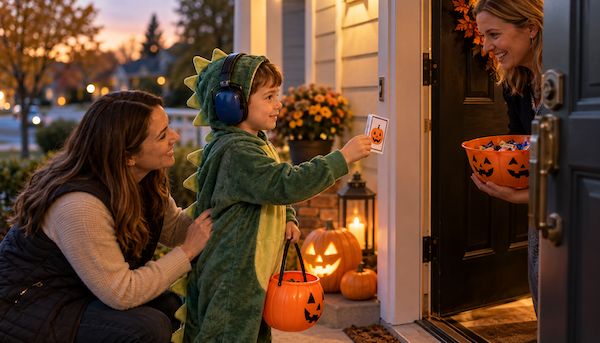
Think about what one short trip down the block asks of a child. They wait in line, knock on a stranger’s door, make a request, take one item, say thank you, and move on. They handle a change in routine, wear new clothes, and see familiar people in unfamiliar faces. Those are the same skills we work on in therapy all year: communication, flexibility, waiting, and tolerating new sensory input.
Halloween just bundles them into one very motivating package. And few things motivate quite like a bag of candy.
First, listen to what your child is telling you
In ABA, we start from a simple idea: behavior is communication. A meltdown on the front porch is rarely “bad behavior.” It is usually your child’s clearest way of saying something they can’t yet put into words.
Before you plan anything, think back to last Halloween (or any busy outing) and ask what your child was trying to tell you:
Recent Posts
- Halloween Is a Skill-Building Season: A Behavior-Minded Guide for Autism Families
- Early Intervention ABA Therapy in Fair Lawn, NJ: Why Starting Early Changes Everything
- 5 Questions to Ask During Your ABA Insurance Benefits Check in 2026
- What Horizon NJ Health’s New 2026 ABA Policy Means for Your Child’s Coverage
- Why Autism Looks So Different Person to Person
- “This is too much.” Covering ears, dropping to the ground, or bolting often means sensory overload. The goal is teaching a way to ask for a break.
- “I don’t know what happens next.” Repeated questions, rigidity, or refusing to leave the house often point to uncertainty. The goal is making the night predictable.
- “I don’t want to do that part.” Refusing to wear the mask or walk up to a door may be about one specific step, not the whole night. The goal is finding and practicing that step.
- “I want more!” Grabbing handfuls of candy or not wanting to stop can simply mean the reward is working. The goal is teaching limits and transitions.
Once you know the “why,” you know which skill to practice. That turns Halloween prep from guesswork into a plan.
A four-week Halloween countdown
Big skills are easier to learn in small steps. Therapists call this shaping: rewarding small steps toward a goal until the whole skill comes together. Here is how that can look in the month before Halloween.
When | Focus | What it looks like at home |
|---|---|---|
4 weeks out | Explore | Look at Halloween photos and store displays together. Let your child pick what interests them and what they want to skip. Notice what they avoid. |
3 weeks out | Choose | Offer two or three costume options and let your child decide. Wear it for 2 minutes, then 5, then 15, with praise and a small reward each time. |
2 weeks out | Rehearse | Practice the door routine at home (see below). Use your own front door, then a grandparent’s or a friendly neighbor’s. |
1 week out | Preview | Make a simple picture schedule for the night: costume, walk, 3 houses, home, trade candy. Review it daily. |
Halloween | Follow the plan | Stick to the schedule, reward the steps you practiced, and end on a success, even if that means going home early. |
Two tools make every stage work better:
- Choices. Letting your child choose (this costume or that one, these three houses or those three) builds buy-in and reduces refusals.
- “First, then.” A clear “First knock, then candy” statement tells your child exactly what earns the reward. Keep it short and consistent.
Five skills worth practicing
You don’t need to practice all of these. Pick the one or two that match what your child told you in step one.
- The door routine. Break it into steps: walk up, knock or ring, wait, say or show “trick or treat,” take one piece, say or show “thank you,” walk away. Practice one step at a time, and reward each step before adding the next.
- Asking for a break. Teach a simple way to say “I need a break”: a word, a sign, a card, or a button on their AAC device. Practice it on calm days first, and honor it every time. A child who trusts the break will come is more willing to keep going.
- Waiting. Use a visual timer or count out loud while waiting for a snack or a turn at home. Start with a few seconds and build up. On Halloween, doors don’t always open right away.
- “No thank you.” Not every house will have a treat your child likes, and some decorations will be scary. Practice politely passing with a phrase, a head shake, or a card. It is a lifelong skill.
- Leaving when it’s time. Transitions are hard, especially away from something fun. Use a countdown (“Two more houses, then home”) and a clear reward waiting at home to make leaving easier.
If your child is nonspeaking or uses AAC, add Halloween words to their device or make a few picture cards: “trick or treat,” “thank you,” “break,” “all done,” and “no thank you.” Communication counts in any form.
The parts nobody plans for
Siblings. Brothers and sisters may want a longer night, a scarier costume, or a big party. When you can, split the evening: one parent heads out with the siblings while the other follows your child’s plan. Give siblings a job, too, like being the “door buddy” who models the routine. Kids often learn fastest from other kids.
The candy bag. Candy can be a powerful reward, and a tough limit. Decide the rules before you leave (for example, one piece per night after dinner) and put them on the picture schedule. A “candy trade” can help: your child swaps pieces they don’t want, or ones that don’t fit their diet, for a small toy or a favorite activity.
The day after. Expect some fallout on November 1. A late night, extra sugar, and a big change in routine can mean a harder morning. Keep the next day quiet and familiar. Then look back at what went well. Did your child knock on a door for the first time? Use a break card? Wear a costume for 20 minutes? Write it down. Those wins are the starting point for next year, and for goals in everyday life.
Success looks different for every child
For one child, a great Halloween is ten houses in full costume. For another, it’s handing out candy from the front step for fifteen minutes. Both are real progress. Measure the night by the skills your child showed, not by how full the bag is.
At AG Behavioral Services (AGBS), our ABA, speech, occupational, and physical therapy teams help children build these everyday skills all year long, from communication and waiting to handling sensory input and change. If you’d like help preparing for Halloween, or any big event on your family’s calendar, we’d love to talk. Contact us or call 201-373-6947 to learn more.
For more ideas on costumes, décor, and sensory-friendly alternatives, see our earlier post, Halloween Tips for Parents of Children with Autism.